
How to Read Palms: A Practical 9-Step Guide for Beginners
A first-hand walkthrough of palm reading — hand shape, thumb, mounts, the four major lines, and the mistakes most beginners make in their first month.
Palm reading looks intimidating from the outside. There seem to be a hundred lines, a dozen mounts, and every book disagrees with the next one. After spending a couple of years reading palms — first my own, then friends', then strangers at parties — I came to a much simpler conclusion: a useful palm reading is mostly the first three minutes, and the rest is detail.
This guide is the workflow I actually use, in order. Nothing here is mystical fluff. If you follow the nine steps below, you will get more out of one careful reading than out of memorizing dozens of obscure symbols.
TL;DR: The 9 Steps of Reading a Palm
If you only remember one thing from this article, remember this checklist:
- Pick the dominant hand. For men, the right hand shows the present and what's developed; the left shows inherited tendencies. For women it's traditionally reversed, though I treat the dominant writing hand as the "main" hand and the other as the "potential" hand — this matches modern handedness better.
- Look at the overall hand shape. Square, long, conic, mixed. This sets the temperament of everything else.
- Examine the thumb. Length, flexibility, set. The thumb is willpower. Without it, all the talents on the palm stay theoretical.
- Check finger proportions and tips. Long vs short, knotted vs smooth, pointed vs spatulate.
- Look at the nails. Color, shape, ridges. This is the cleanest health signal on the hand.
- Read the seven mounts. Jupiter, Saturn, Sun, Mercury, Mars, Moon, Venus. The mount that's most developed tells you what the person reaches for instinctively.
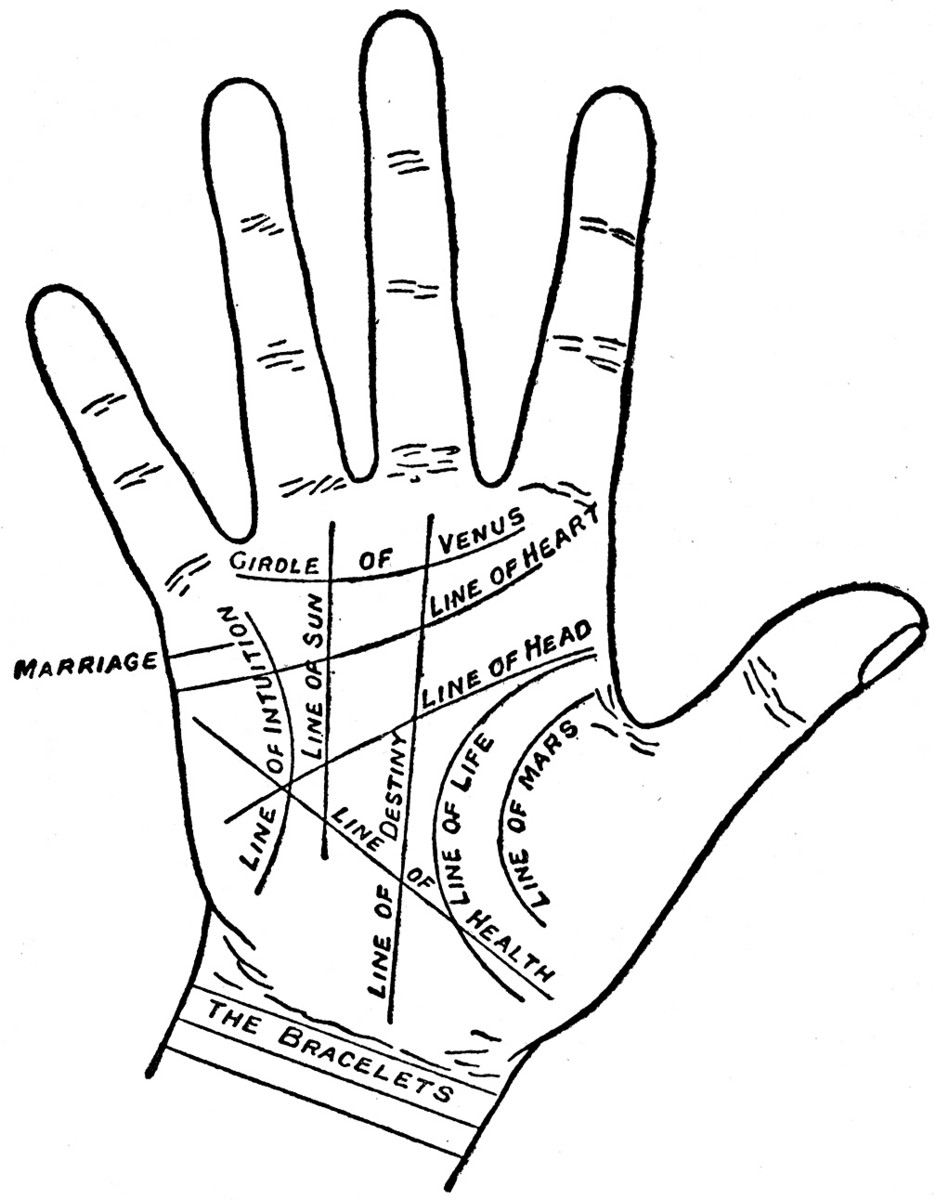
- Read the four major lines, in this order: Head Line → Life Line → Heart Line → Fate Line.
- Look at minor lines and special signs (Girdle of Venus, Ring of Solomon, Mystic Cross, etc.) — but only after the four major lines are clear.
- Date events carefully. Use the seven-year segment method on the Life Line and Fate Line, and resist the urge to read more than 1–2 years into the future. I'll come back to this in the limitations section — this is the single biggest mistake beginners make.
That's the entire framework. Everything below is just how to do each step well.
Before You Start: Two Things Most Books Don't Tell You
Lighting matters more than people admit
I've read the same palm under fluorescent office light and under window daylight in the same hour and reached noticeably different conclusions on faint lines. Under bad light, a fading head line can look broken; an island can look like a chained section; a healthy pink palm can look pale and "unhealthy."
My rule now: read in soft, indirect daylight whenever possible. Avoid direct overhead light (it flattens the relief), avoid yellow incandescent bulbs (they bias the color reading toward "warm = good"), and never trust an outdoor reading in midday sun where the hand sweats and reddens within minutes.
If you're using an app or photo-based reading, the same rule applies — a hand photographed at night under a phone flash will produce a worse reading than the identical hand photographed near a window an hour later.
Hands are not still photographs
Lines change. Not constantly, but they change. Heart-line forks deepen with age. New worry lines appear after a hard year. Faint fate lines can solidify after someone finally finds direction in their thirties. This means palm reading is a snapshot, not a horoscope. A good reading describes who someone is now, with cautious extrapolation forward.
Step 1: Which Hand Do You Read?
Classical Western palmistry says: men show the right hand as "developed/present," left as "inherited/past"; women show the reverse. Indian palmistry mostly follows the same idea but treats the right hand as primary for men and left for women.
In practice I treat it more simply:
- Dominant (writing) hand → who you are now.
- Non-dominant hand → what you came in with.
If both hands say the same thing on a given line, that's a strong signal. If they disagree, the dominant hand wins for present-day judgment, and the non-dominant hand tells you what was either undeveloped or actively suppressed.
A common misread: someone has a beautiful sun line on the non-dominant hand only. Beginners get excited and predict fame and fortune. In reality, that's potential that has not yet been developed — the dominant hand is what's actually playing out.
Step 2: Hand Shape
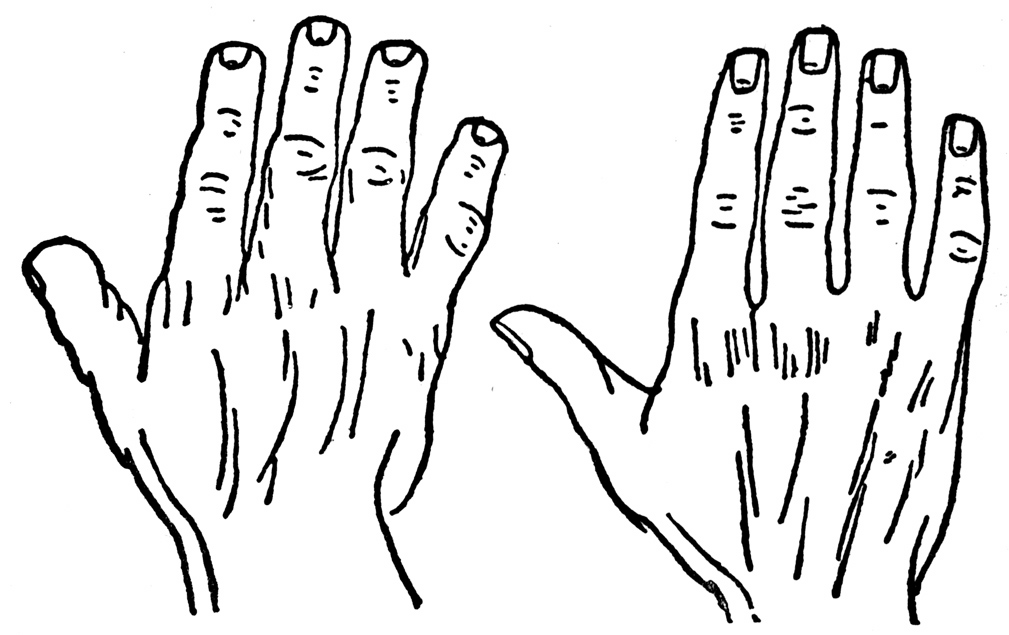
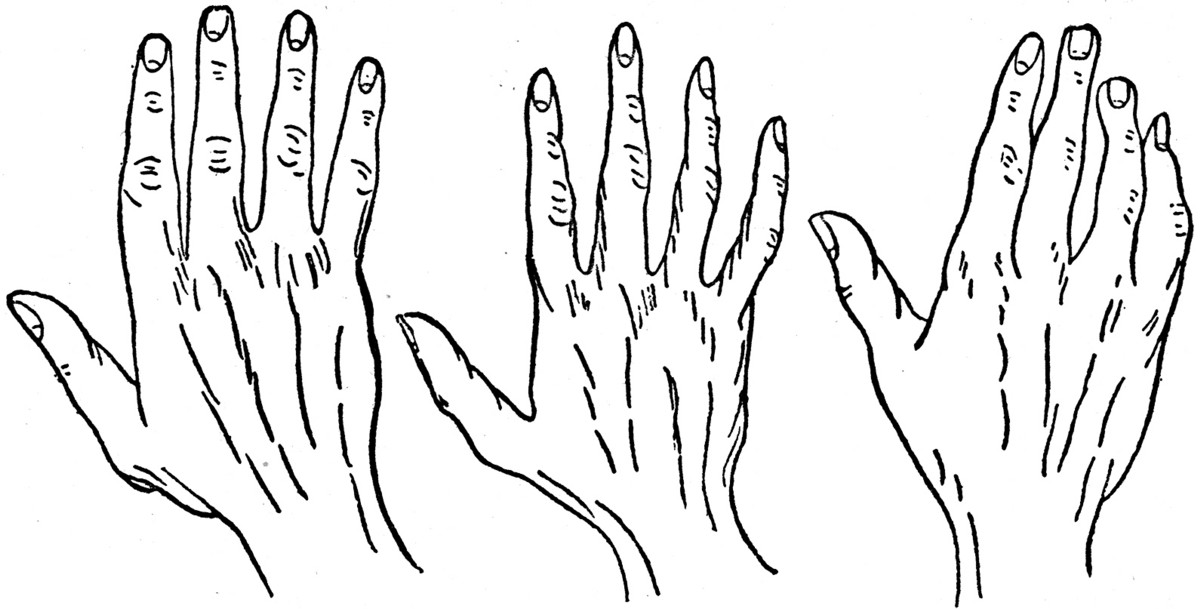
Before you touch a single line, look at the overall hand. The classical seven-type system collapses pretty cleanly into four practical categories:
| Shape | Look | What it usually means |
|---|---|---|
| Square | Square palm, square fingertips, sturdy thumb | Practical, methodical, evidence-based. Good for engineers, doctors, builders. |
| Long / Philosophic | Long palm, knotty fingers, bony | Analytical, reflective, drawn to ideas and solitude. |
| Conic / Artistic | Rounded fingertips, soft palm | Emotional, aesthetic, expressive. Often needs structure to actually finish things. |
| Spatulate | Fingertips fan out at the tip | Original, energetic, doesn't follow rules. Inventors, founders, athletes. |
A mixed hand (different finger types on the same hand) is the most common shape on real people. It means versatility, but also means you must rely on the head line to figure out where the focus actually is.
The firmness matters too. Soft and fat = lazy or under-disciplined. Firm and elastic = active and reliable. Cold and clammy = nervous, sensitive, often physically delicate.
Step 3: The Thumb
If I had to read a hand with only one feature, I would pick the thumb. The thumb is willpower, and willpower is what converts every other talent into actual results.
Three things to check:
- Length. Reaching past the lowest crease of the index finger = strong will. Falling short = weak follow-through, even if every other line is excellent.
- Flexibility. Bends back easily = generous, adaptable, sometimes too easily swayed. Stiff and straight = stubborn, principled, hard to move.
- The two phalanges. Top phalange = will. Bottom phalange (with the curve of Venus) = logic. The longer one wins. A long top, short bottom = acts first, thinks later. The reverse = thinks endlessly, acts rarely.
Step 4: Fingers and Nails
Fingers are usually skimmed too fast. Two quick checks pay off:
- Length relative to palm. Fingers shorter than the palm = quick, intuitive, impatient with detail. Fingers longer than the palm = slow, thorough, sometimes nitpicky.
- Knotted vs smooth joints. Knotted (visible joints) = analytical, breaks things down. Smooth = grasps things whole, more intuitive.
Nails are the cleanest health signal you'll get from a hand:
- Healthy pink, smooth, slightly arched = good circulation, steady nervous system.
- Pale or bluish = poor circulation.
- Vertical ridges = nutrient or stress issues, common after a hard year.
- Spoon-shaped (concave) = often anemia.
- Unusually short and wide = can correlate with cardiovascular concerns in older subjects (treat this as a "go see a doctor" hint, not a diagnosis).
Step 5: The Seven Mounts
The mounts are the fleshy pads at the base of each finger and along the edges of the palm. Whichever mount is most developed tells you what that person reaches for instinctively.
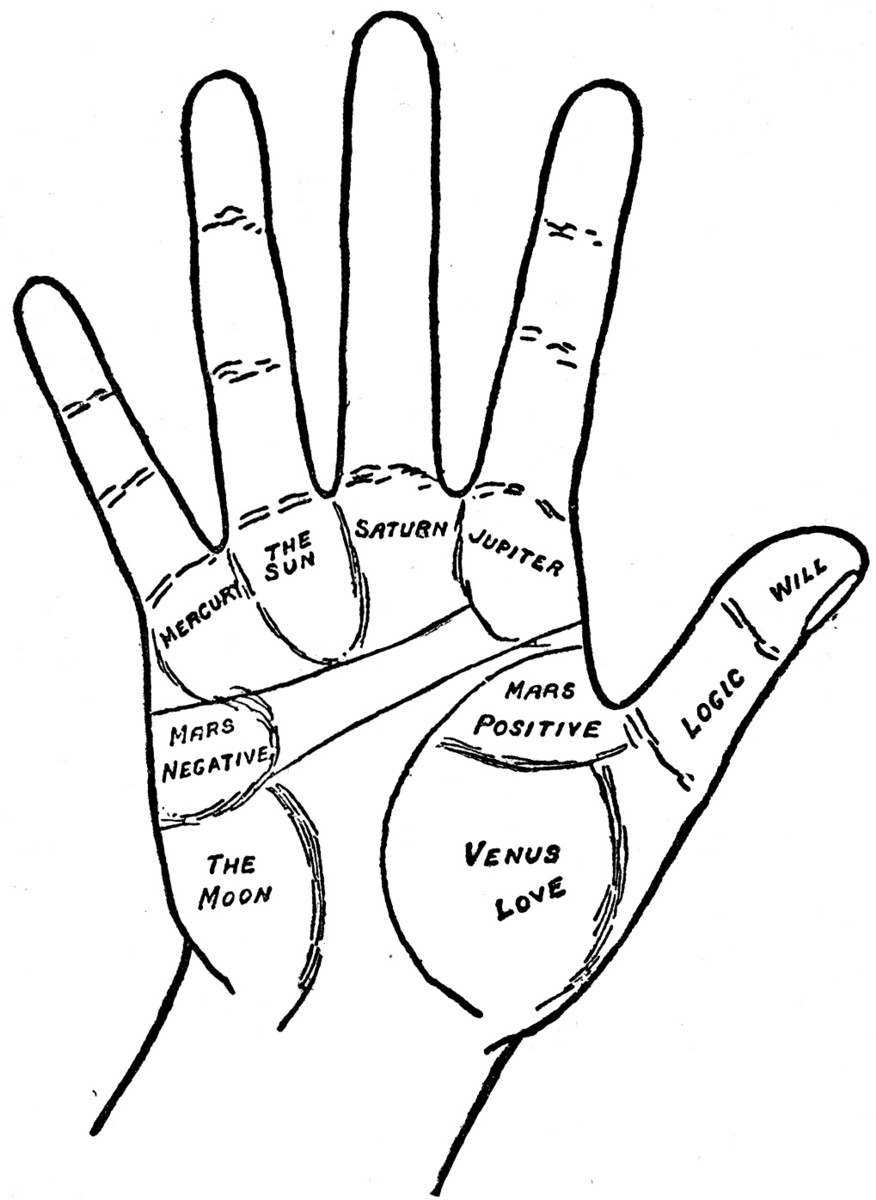
- Jupiter (under the index finger): ambition, leadership, ego.
- Saturn (under the middle finger): discipline, seriousness, sometimes melancholy. Rarely the dominant mount, and when it is, the person is unusually grave.
- Sun / Apollo (under the ring finger): art, recognition, charm.
- Mercury (under the pinky): communication, commerce, quickness.
- Mars (two zones — between thumb and index, and below Mercury): courage, endurance, fight.
- Moon (heel of the palm, opposite the thumb): imagination, intuition, restlessness.
- Venus (the fleshy pad at the base of the thumb): love, vitality, sensual energy.
A flat-mounted hand belongs to someone whose drives are quiet — not a problem, just a different temperament. A hand where every mount is overdeveloped belongs to someone who wants too many things at once and rarely finishes any of them.
Step 6: The Four Major Lines
Read them in this order: Head → Life → Heart → Fate. Most beginners start with the life line because it's the most famous. That's a mistake. The head line is the compass; if it's clear and well-placed, even a chaotic-looking hand can produce a successful life.
Head Line
Runs horizontally across the middle of the palm.
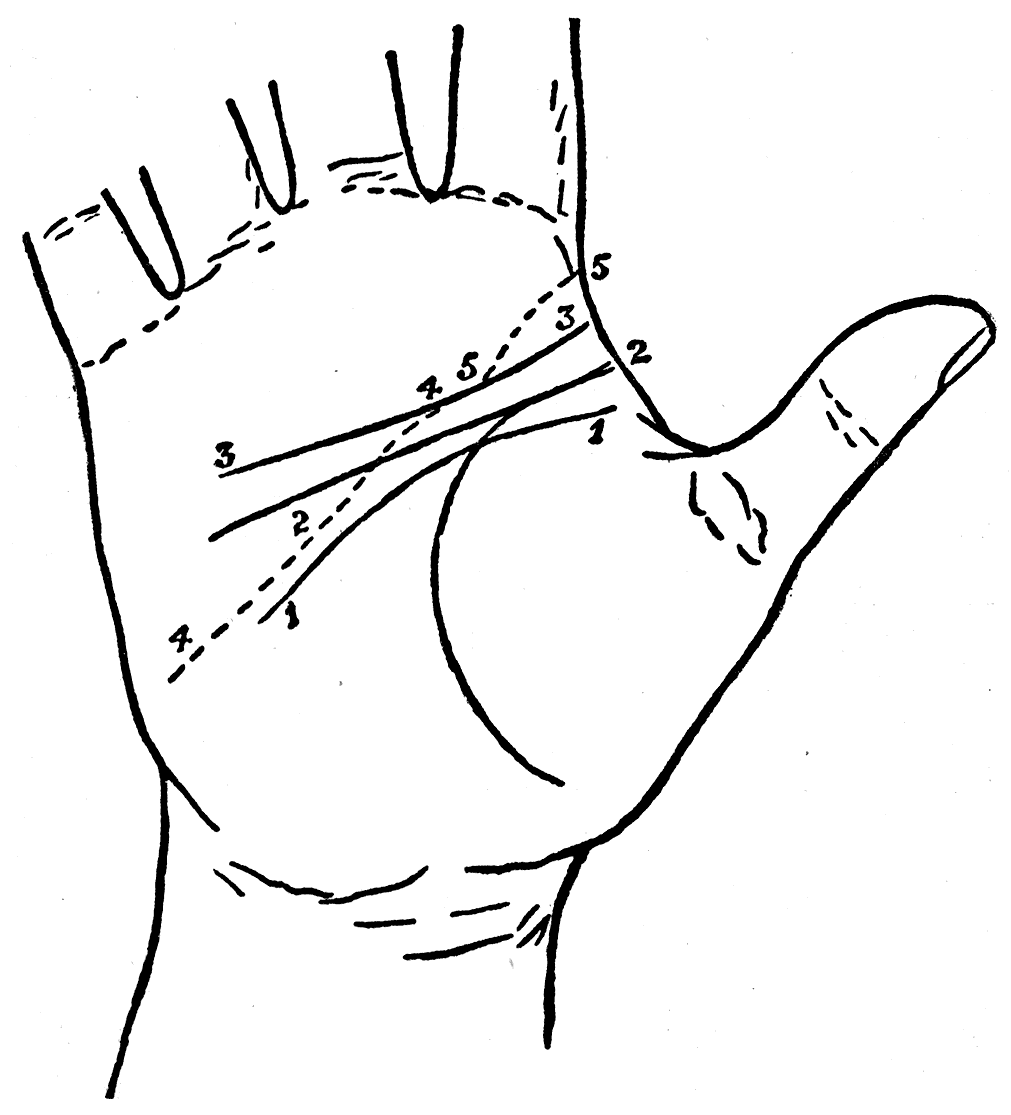
- Straight across: practical, business-minded, level-headed.
- Sloping down toward the moon mount: imaginative, creative. A gentle slope is great. A steep slope into the lower moon mount is the most common signal of melancholy I've seen.
- Forked at the end: a "writer's fork" — the ability to hold both practical and imaginative perspectives.
- Chained or islanded: mental fatigue, anxiety, periods of overload.
- Joined to the life line at the start: cautious, sensitive. Common in artists and thoughtful types.
- Clearly separated from the life line: independent, decisive, sometimes reckless.
Life Line
The arc around the thumb. Length is not lifespan. Repeat this until you stop thinking otherwise. Length on the life line correlates with vitality and how easily someone bounces back from illness, not with how many years they will live.
- Deep and clean = strong constitution.
- Wide and shallow = looks healthy, but lower resilience under real stress.
- Chained = childhood frailty, often outgrown.
- Branches rising up = ambitious upward turns; branches falling down = energy leaks (overwork, illness, lifestyle drains).
Heart Line
Runs across the palm under the fingers.
- Starting under Jupiter: idealistic, loyal, the "marries one person and stays" pattern.
- Starting between Jupiter and Saturn: the most common — balanced affection, capable of long relationships without being naive.
- Starting from Saturn: more self-interested in love. Not "bad," just realistic about what they want.
- Chained with many small branches: affectionate but restless; many short connections.
- Ruler-straight, no branches: reserved, hard to read emotionally.
- Merged with the head line as one line (Simian line): rare, intense, single-minded — both gift and risk.
For the short horizontal lines that sit beside the heart line and record relationship history, see the marriage line guide.
Fate Line
Runs vertically up the palm toward the middle finger. This is the line that people most want to hear about, and the one I'm most cautious with.
- Starting from the wrist, straight up: classic strong-direction life.
- Starting from the moon: career shaped heavily by other people (partners, mentors, public).
- Starting from the life line: self-made, often after early-life constraints.
- Faint or absent: not a bad sign. Many successful, happy people don't have a strong fate line. It usually just means life has been less linear and less driven by a single thread.
Step 7: Minor Lines and Special Signs
Only check these once the four majors are clear:
- Girdle of Venus (a half-circle above the heart line): heightened sensitivity, often emotional volatility.
- Ring of Solomon (a small arc around the base of the index finger): intuition, sometimes a teaching/counseling instinct.
- Mystic Cross (a cross in the quadrangle between head and heart lines): interest in the unseen — religion, mysticism, psychology.
- Travel lines (horizontal lines on the percussion edge): journeys that mattered; not every trip leaves a line.
Beginners over-weight these. They are accents, not headlines.
Step 8: Marks and Symbols
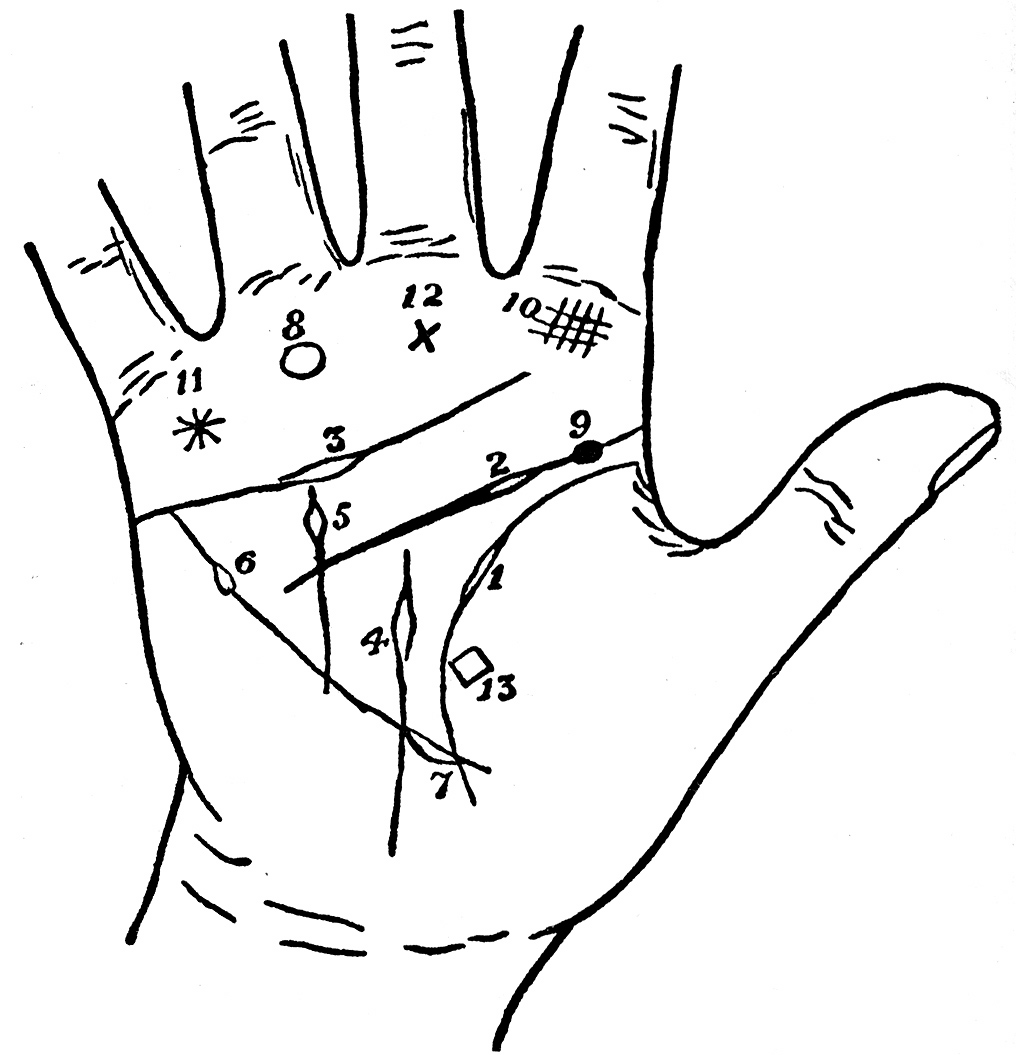
Stars, crosses, squares, islands, triangles, grilles, dots, chains. Quick read:
- Star: sudden event at that point — usually dramatic, can be good or bad depending on location.
- Cross: obstacle or warning.
- Square: protection. The single most welcome sign on a damaged line.
- Island: weakening of whatever the line represents during that period.
- Triangle: ability or success in the area of the mount where it appears.
- Grille: scattered, dissipated energy on that mount.
- Chain: slow, draining period rather than a sharp event.
Step 9: Dating Events — and Why I Don't Trust It Past Two Years
The classical method divides the life line into seven-year segments and the fate line into ages by where it crosses the head line (around 35) and the heart line (around 49). The math works tidily on paper.
In practice, I'll be honest: I don't trust dated predictions more than about one to two years out. Here is why I came to this view, with three reasons:
- Lines actually change. I've seen new branches appear on a fate line within eighteen months after someone changed careers. If the line itself is moving, dating events on it five years out is reading a map that's still being drawn.
- The smaller the time window, the higher the confidence. "Stress and a likely health dip in the next 12 months" is testable and often correct. "A major career change at 47" is the kind of statement that survives by being unfalsifiable until far too late.
- External events dominate. A strong star on the sun mount means almost nothing to someone whose industry collapses next year. Palmistry describes the person, not the world they live in. The further out you go, the more the world matters.
So: I'll happily read the next year or two from a hand. Beyond that I treat the lines as describing tendencies, not scheduling events.
Personal Limitations to Be Honest About
A few more things I've learned the hard way:
- A single "good line" doesn't make a good reading. You can have a brilliant sun line and a chained head line and the chained head line wins. The hand reads as a whole.
- Symmetry between the two hands is the strongest confidence signal. Anything that appears on both hands is roughly twice as worth saying.
- Reading your own hand is the hardest hand to read. You bring too much hope and too much worry. I read my own palm maybe once a quarter and assume I'm 30% wrong about what I see.
- Health hints belong in plain language, not as predictions. "Your nails suggest you might be running anemic, get checked" is useful. "Your life line is cut short at 47" is irresponsible and probably wrong.
Frequently Asked Questions
Which hand should I read? Dominant (writing) hand for who someone is now; non-dominant for inherited tendencies. If they disagree, present-day reality lives on the dominant hand.
Does a short life line mean a short life? No. Length on the life line maps to vitality and resilience, not lifespan. I've read short life lines on people in their nineties.
Can palm lines change? Yes. Major lines are mostly stable, but minor lines, branches, and especially the fate line can deepen, fade, or fork over years.
How accurate is palm reading? For describing someone's temperament, drives, and current state — surprisingly accurate when done carefully. For predicting specific future events — unreliable beyond 1–2 years, in my experience. Treat it as a character read with a short forecast window, not a fortune-teller.
Is palmistry scientific? No, and pretending otherwise wastes everyone's time. It's a traditional system of pattern recognition over hand anatomy, gesture, and surface markings. Some of those patterns (nail health, hand temperature, tremor) overlap with real medical signals; most of the rest is psychology under another name.
What's the best way to learn? Read lots of hands. The classical sources (Cheiro's Palmistry for All, 1916; Mrs. J.B. Dale's Indian Palmistry, 1895) are public-domain starting points and well worth reading. But two hundred careful readings will teach you more than any book.
Where to Go From Here
If you want a quick reading on your own palm without working through this whole framework, you can scan your hand on the Scan page — it walks through the same nine steps automatically and produces a structured report in about a minute. The model is trained on the same classical material this guide draws from.
For deeper dives, follow-up articles in this series will go line by line: heart line, head line, fate line, and the most-asked-about minor signs (Mystic Cross, Ring of Solomon, simian line). Bookmark this page and come back — the goal here is to build something usefully short rather than encyclopedically long.
Image credits. All illustrations on this page are reproduced from Cheiro's Palmistry for All (G.P. Putnam's Sons, 1916), now in the public domain. Scans courtesy of Project Gutenberg.